How to Choose a Baby Monitor? Buying Guide for Parents
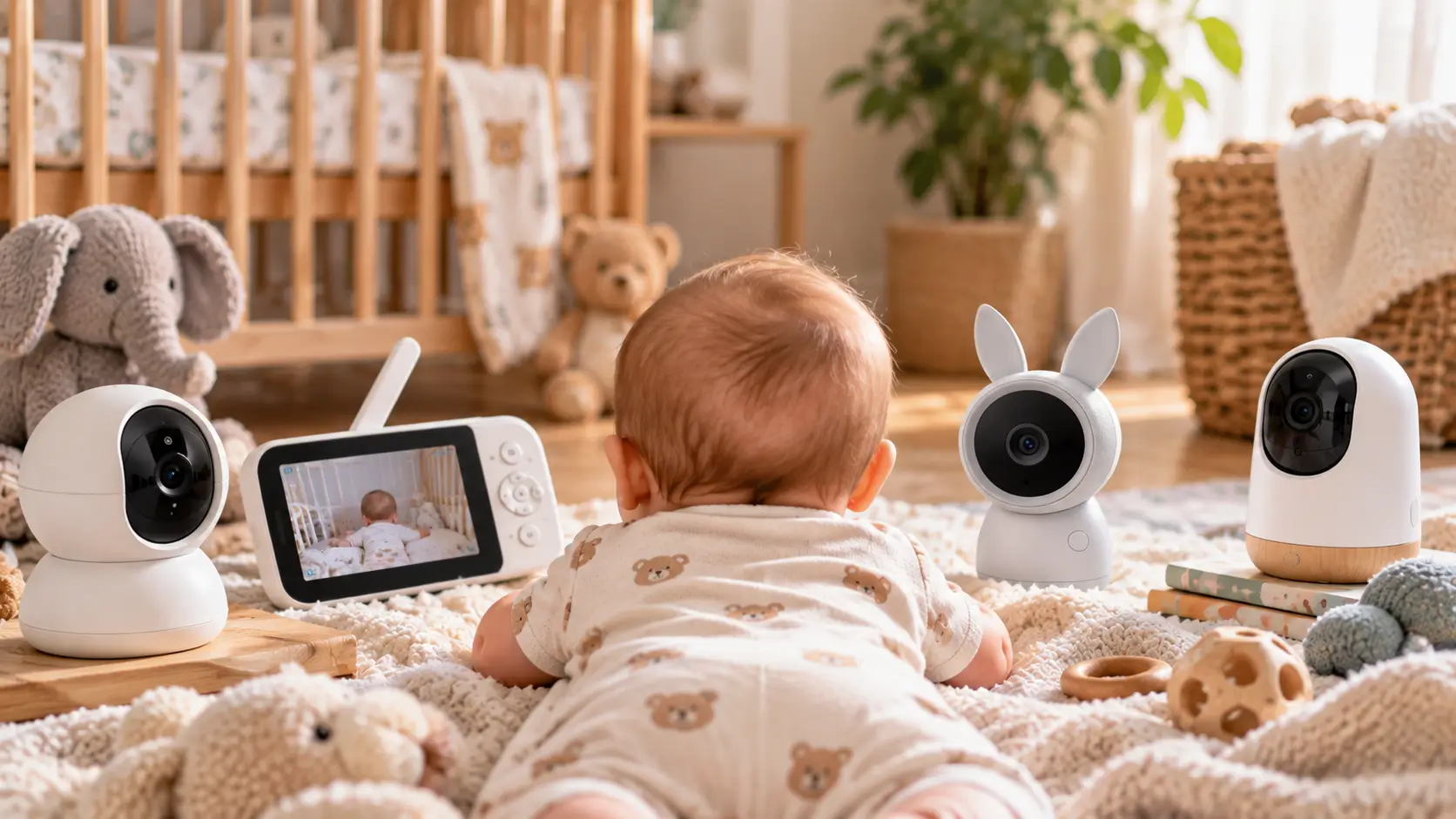
Choosing a baby monitor involves much more than deciding whether you want audio or video. Does the monitor need to work without WiFi? How much range do you need? Do you want a separate parent unit, a smartphone app, or both? How important are night vision, battery life, or support for two cameras?
In this guide, we will go through the most important features to consider when comparing baby monitors and help you choose the right solution for an apartment, house, travel, or monitoring multiple children.
Baby Monitor With or Without a Camera?
Baby monitors generally fall into two categories:
- Audio baby monitors – transmit sound only
- Video baby monitors – transmit both sound and video
Before buying, decide whether audio alone is enough for you or whether you also want to see your baby on video.
The main advantages of audio-only baby monitors are longer battery life and a more compact design. This makes them easy to carry and convenient to place near your baby – there is no need to adjust the camera angle; you can simply position the monitor close to your baby.
A video baby monitor gives parents greater reassurance when they are away from their baby, as they can see in real time whether everything is okay, respond immediately when necessary, and avoid unnecessary interruptions. Video can also help you notice situations where your child may be at risk without making any noise, such as a choking hazard, a fall, or interference from pets. These situations may go unnoticed with an audio-only monitor. A video feed can provide greater peace of mind and a stronger sense of security for the whole family. However, it is important to remember that a baby monitor is not a substitute for providing a safe sleeping environment or for adult supervision.
If you want greater visibility and reassurance, choose a model with a camera. If simplicity and flexibility are more important to you, an audio-only monitor may be the right choice.
WiFi or Radio Connection – Which Is Better for You?
When choosing a baby monitor, you need to decide which type of connection you prefer:
WiFi Baby Monitors
- ☑️ Access the baby monitor through a smartphone, tablet, and sometimes a computer
- ☑️ Monitor your baby remotely, for example from work
- ❌ Requires an internet connection
- ❌ The manufacturer’s security measures are particularly important and should be carefully considered before buying
Radio Baby Monitors
- ☑️ Simple and reliable – does not depend on an internet connection
- ☑️ Generally less vulnerable from a cybersecurity perspective
- ☑️ A dedicated screen allows you to monitor your baby without distractions
- ❌ Limited by the range of the radio signal
- ❌ No remote viewing through an app
Combined WiFi and Radio Baby Monitors
Newer models include both WiFi and a radio connection, allowing you to use either one depending on the situation.
- ☑️ Ability to choose the most suitable connection depending on the situation
- ☑️ Backup connection – if one connection does not work well enough, you can switch to the other
- ❌ Higher price – these monitors generally cost slightly more than other models
If you want to monitor your baby remotely, for example from work or while travelling, choose a WiFi monitor. If you value simplicity and reliability and do not need remote viewing, a radio baby monitor may be more suitable. A combined monitor offers the advantages of both if you are willing to pay a little more. We recommend choosing a combined solution because it provides greater flexibility and reliability in different situations.
Screen and Camera Quality
When choosing a video baby monitor, it is worth looking not only at the camera resolution but at the overall image quality.
- Screen size – choose a screen that is large enough to monitor your baby comfortably and, if necessary, view feeds from multiple cameras. A 4.3-5-inch screen is usually a good compromise between size and convenience.
- Resolution – we recommend choosing a camera with at least 720p resolution so that the image is sufficiently clear and detailed. A higher resolution may provide better image quality, but the quality of the screen itself is also important.
- PTZ function – allows you to remotely pan, tilt, and zoom the camera. This is particularly useful if your child moves out of the camera’s field of view while sleeping or playing.
- Viewing angle – the wider the camera’s field of view, the more of the room you can see at once and the less often you need to reposition the camera.
Baby Monitor Range
A baby monitor’s range indicates how far apart the parent unit and camera can be while maintaining a stable connection. This is particularly important in larger homes, multi-storey houses, or when you want to use the monitor on a terrace or in the garden.
A manufacturer’s stated range, such as 300 metres, usually refers to the maximum distance in an open area under ideal conditions. In a home environment, the actual range may be considerably shorter because the signal can be affected by walls, floors, metal structures, reinforced concrete, and other wireless devices.
- In an apartment, maximum range is usually not the most important factor because distances are relatively short. A stable connection through one or more walls matters more.
- In a two- or three-storey house, it is worth choosing a monitor with a strong and reliable connection that also works well through floors and ceilings.
- When using the monitor on a terrace or in the garden, keep in mind that the connection may perform better outdoors than through several walls, although the actual result still depends on the building’s construction and the distance involved.
- With a WiFi baby monitor, the range largely depends on the quality of your home WiFi network. If WiFi coverage is weak in certain rooms, the baby monitor connection may also become unstable there.
If you plan to use the monitor in a larger house or on different floors, look not only at the manufacturer’s stated maximum range but also at user experiences in real home environments.
A good rule of thumb is to choose a monitor with more range than you actually expect to need. This reduces the likelihood of the signal becoming unstable.
Battery Life and Ease of Use
The everyday convenience of a baby monitor depends largely on how the device works and how long its battery lasts. Most baby monitors are designed so that the parent unit or screen runs on a rechargeable battery, while the camera positioned near the baby needs to be connected to mains power.
If you use the monitor every day, particularly in the evenings and at night, battery life is one of the most important factors. A device with poor battery life can quickly become inconvenient because it may need constant charging precisely when you need it most.
When choosing a baby monitor, pay attention to the following:
- Real-world battery life – manufacturers’ claims do not always reflect real-world usage. A good monitor should last for at least several hours continuously, and ideally throughout the baby’s entire sleep period.
- Wireless parent unit – can you freely carry the screen from room to room, or does it need to remain connected to a power outlet?
- Charging convenience – USB charging is generally easier and more practical than using a charger with a proprietary connector.
- Low-battery alerts – does the device notify you when the battery is running low?
The best baby monitors offer a rechargeable, lightweight parent unit that you can easily carry around your home. This gives you more freedom of movement and reassurance that you can remain connected to your child wherever you are in the house.
Night Vision and Sound Sensitivity
A good baby monitor should work just as well at night as it does during the day, as nighttime is when monitoring is often most important.
Check whether the device includes:
- Night vision – provides a clear image even in complete darkness
- Adjustable sound sensitivity – prevents every small sound from triggering an unnecessary alert
- VOX function – activates the monitor only when sound is detected
Night vision quality can vary considerably between models, so it is worth choosing a device that provides a sharp and clear image even in low-light conditions.
Adjustable sound sensitivity helps prevent the monitor from reacting to every background noise while still allowing you to notice your baby’s cries and other important sounds.
The VOX function is particularly useful for saving battery power and providing a calmer monitoring experience, as the screen and audio activate only when your baby makes a sound.
Security – Data Protection and Privacy
Security is particularly important with WiFi baby monitors, as the video feed is transmitted over the internet. Before buying, it is therefore worth making sure that the device uses reliable security measures.
Make sure to check:
- whether the connection and video feed are encrypted
- whether the user account has strong password protection
- whether the manufacturer provides software and security updates
- whether cloud storage can be disabled if desired
- how access can be shared with other family members
Choose well-known and reputable brands with carefully designed security solutions. For example, Philips, Arenti, Motorola, and Britton are popular choices among parents.
Smart Additional Features That Can Be Useful
Modern baby monitors offer a wide range of additional features:
- 📢 Two-way audio – allows you to talk to your baby
- 🌡️ Temperature and humidity sensor – monitors the environment in your baby’s room
- 🎶 Soothing sounds or melodies – can help your baby fall asleep
- 📷 Multi-camera support – useful for monitoring multiple children or a larger room
- 🔔 Smart app notifications – alerts you to movement, sound, or temperature changes
- 🗜️ Tripod or universal mounting support
Think carefully about which features will genuinely be useful to you and which are simply “nice extras”.
How to Make the Final Decision
Before buying, think about where and how you will use the baby monitor most often. This makes it easier to distinguish genuinely useful features from those that are not worth paying extra for.
Ask yourself:
- Is audio enough, or do I also want video?
- Do I need a separate screen, a smartphone app, or both?
- Does the monitor need to work without WiFi?
- How much range do I need in my home?
- How important is battery life?
- Do I need support for two cameras or other additional features?
- Is the device easy to use, and is the connection secure?
Summary
A good baby monitor is not necessarily the most expensive model or the one with the longest list of features. The most important thing is to choose a monitor based on where and how your family plans to use it.
For most families, it is worth choosing a model with good night vision, a stable connection, a parent unit with sufficient battery life, and two-way audio. If you want to use a dedicated screen at home while still having the option to occasionally check on your baby remotely from your phone, a combined WiFi and radio baby monitor is the most flexible solution.
If you have more than one child, be sure to check whether the monitor supports multiple cameras and whether the screen can display both camera feeds at the same time.
If you’re looking for high-quality baby monitors or WiFi cameras at a great price, take a look at our online store. We offer fast delivery (usually within 2-5 business days) and products packed with useful features.